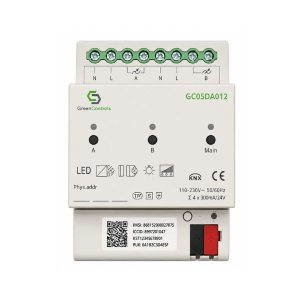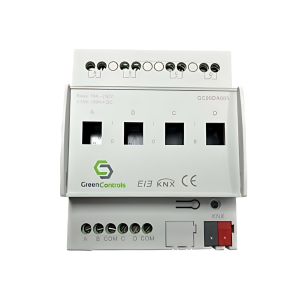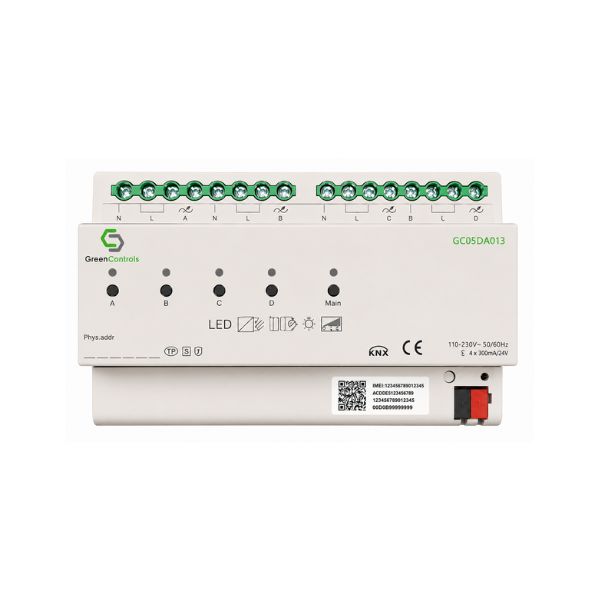
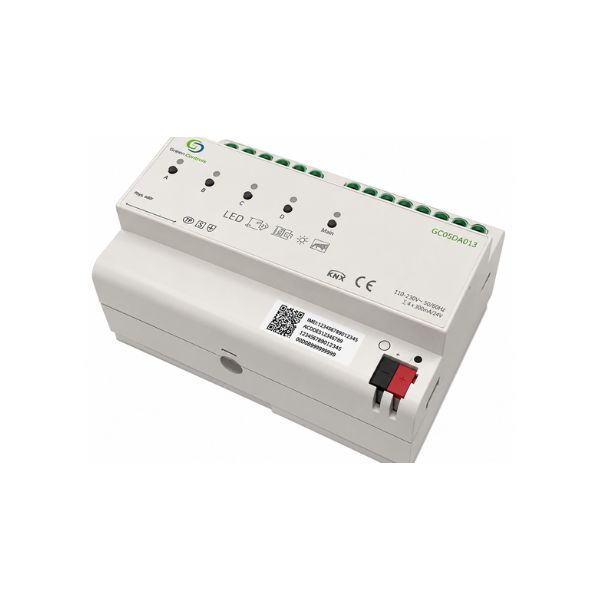
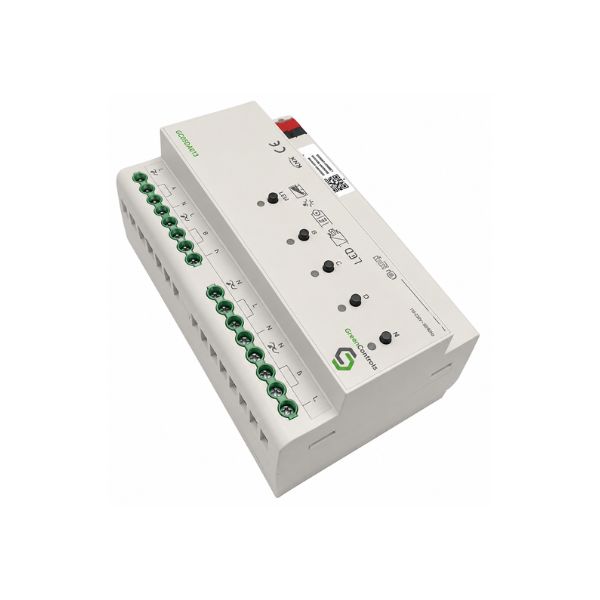
The Universal Dimming Actuator is an advanced lighting control device designed for installation within a distribution board, offering full support for both leading edge and trailing edge phase-cut dimming. This dual-technology approach makes it highly versatile and capable of controlling a wide range of load types, including incandescent lamps, 230 V AC halogen lamps, and low-voltage halogen lamps operated on either conventional (inductive) or electronic (capacitive) transformers. By automatically or manually selecting the appropriate dimming method, the actuator ensures reliable performance, improved energy efficiency, and optimal compatibility with modern and traditional lighting technologies.
A key feature of the Universal Dimming Actuator is its ability to control up to six different dimming curves, which include Linear, Exponential, Cubic, Quadratic, Logarithmic, Root, and even user-defined curves. These curves allow precise adjustment of the dimming response to match the specific behavior of the connected lamps or to meet user comfort and aesthetic requirements. For instance, logarithmic or exponential curves may be chosen to provide a more natural perception of brightness to the human eye, while linear or cubic curves may be applied for technical or decorative lighting scenarios. The user-defined curve option provides maximum flexibility by enabling completely customized dimming profiles tailored to unique project needs.
Each dimmer channel can be individually parameterized through ETS (Engineering Tool Software), giving system integrators the ability to configure minimum and maximum dimming thresholds, fade-in and fade-out times, soft start and soft off behaviors, and curve selection. This level of customization ensures smooth dimming transitions, reduced flicker, enhanced lamp longevity, and user comfort. Additionally, the actuator incorporates advanced safety and diagnostic features such as overload protection, short-circuit protection, and thermal monitoring, which work together to protect both the device and the connected lighting circuits.
Connection to the KNX bus system is established via a dedicated bus connection terminal, allowing seamless integration into KNX-based building automation networks. Once connected, the actuator can be controlled individually or in groups, and can be incorporated into intelligent functions such as scene control, time-based scheduling, centralized monitoring, and remote access via KNX visualization platforms. Each channel also supports up to 16 scene configurations, enabling users to create and recall multiple predefined lighting settings for different environments and usage scenarios. This integration supports both residential and commercial applications where flexibility, energy efficiency, and user comfort are priorities.